Why India Banned Paid Surrogacy: Altruistic vs Commercial Frameworks Explained

Dr Mannan Gupta
Medically Reviewed by Dr. Mannan Gupta On October 30, 2027
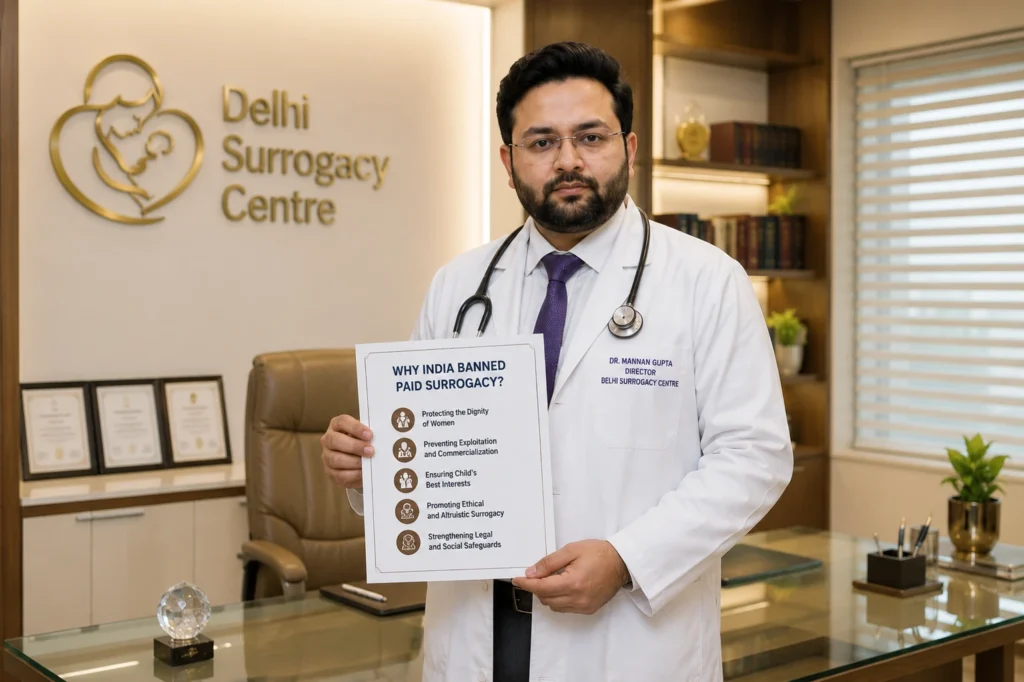
For couples facing severe reproductive challenges, finding a clear, legal path to parenthood can feel overwhelming. The landscape of assisted reproduction changed dramatically when India shifted away from being an international hub for commercial fertility contracts.
If you are currently exploring your options, understanding why India banned paid surrogacy is essential to protecting your family from severe regulatory setbacks and financial risks. This guide breaks down the transition from commercial arrangements to the strictly monitored altruistic framework. Dr Mannan Gupta, leading fertility expert at Delhi Surrogacy Centre – Best IVF & Surrogacy Clinic in Delhi, provides this detailed, evidence-based review to help you navigate your treatment path with absolute peace of mind.
Our modern facility is situated at 29, Ring Rd, Block L, Lajpat Nagar IV, Lajpat Nagar, New Delhi, Delhi 110024. Here, we prioritize customized planning, clinical optimization, and strict statutory alignment, ensuring your path to parenthood is ethically sound and legally secure.
The Historical Shift: Understanding Why India Banned Paid Surrogacy
The transition from a commercial model to a strictly altruistic framework was catalyzed by the need to eliminate the exploitation of economically vulnerable women. For over a decade, unregulated commercial practices operated with minimal legal oversight, turning a deeply personal medical journey into a transactional marketplace.
The Indian government intervened decisively by enacting the Surrogacy (Regulation) Act, 2021, which completely outlawed any form of commercialized or paid arrangements.
The legislature identified specific socio-ethical issues that made a complete ban on commercial surrogacy necessary:
- Preventing systemic exploitation: The commercial model frequently targeted low-income women who entered arrangements under severe financial duress, often without understanding the long-term physical risks involved.
- Eliminating unregulated middlemen: A vast network of unauthorized agents and commercial handlers prioritised corporate margins over the health, postpartum recovery, and psychological well-being of the surrogate mothers.
- Eradicating legal citizenship disputes: The lack of statutory boundaries led to severe legal deadlocks, leaving several children born to international citizens stateless and stuck in prolonged custody battles.
- Curbing unethical multiple pregnancies: Unregulated operators frequently transferred multiple embryos simultaneously to guarantee a birth, severely compromising the surrogate mother’s safety.
By enforcing a complete ban, the Ministry of Health and Family Welfare re-established surrogacy as an act of compassion rather than a commercial service.
Under the current legal framework, any individual or center found organizing, advertising, or exploiting a woman for paid surrogacy faces severe criminal charges, including non-bailable imprisonment for up to 10 years and punitive fines up to 10 lakh Indian Rupees (INR).
The Altruistic Surrogacy Model vs Commercial Surrogacy
To build a family legally under the current framework, intending parents must understand how the permitted altruistic structure differs from the banned commercial model.
The statutory boundaries established by the government ensure that zero commercial elements influence the medical process.
| Statutory Parameters | Banned Commercial Surrogacy | Permitted Altruistic Surrogacy |
| Financial Compensation | Direct payments, payout packages, or cash rewards given to the surrogate mother. | Absolutely zero financial compensation, cash payouts, or monetary rewards permitted. |
| Allowable Expenses | Unmonitored cash transactions disguised as lifestyle or premium maintenance fees. | Strict coverage restricted to actual medical bills, pharmaceutical supplies, and pregnancy care. |
| Insurance Framework | Short-term medical coverage or no formal insurance protection for the surrogate. | Mandatory 36-month comprehensive health insurance architecture protecting the surrogate mother. |
| Surrogate Eligibility | Vulnerable individuals hired repeatedly, often without any genetic or familial verification. | Married women aged 25–35 with at least one biological child, allowed to act as a surrogate only once. |
The altruistic model ensures that the entire process is driven by emotional support and medical necessity.
Intending parents must secure a formal Certificate of Medical Necessity from a District Medical Board before starting any clinical procedures.
Advanced Services & Solutions Offered at Delhi Surrogacy Centre
Navigating an altruistic treatment cycle requires a precise balance of cutting-edge reproductive science and strict statutory verification.
At Delhi Surrogacy Centre – Best IVF & Surrogacy Clinic in Delhi, we provide a highly structured clinical environment designed to achieve evidence-based success while ensuring full legislative compliance.
Flawless Statutory Compliance & Document Verifications
- District Medical Board liaising: Our legal operations team guides intending parents through the complex process of obtaining the mandatory Certificate of Medical Necessity and Essentiality.
- Surrogate verification protocols: We manage comprehensive screening checks to confirm that the surrogate mother meets all criteria under the Surrogacy (Regulation) Act, including age, marital history, and previous pregnancy records.
- Strict parentage filing: We assist your legal counsel in processing the necessary post-birth magistrate orders to ensure the seamless issuance of the child’s birth certificate.
Advanced ICSI and Embryology Laboratory Infrastructure
- Intracytoplasmic Sperm Injection (ICSI): Our advanced embryology lab utilizes high-magnification micromanipulation to optimize fertilization rates, particularly for severe male factor infertility.
- Donor gamete integration: Fully aligned with the landmark Surrogacy (Regulation) Amendment Rules, 2024, we provide legal routing for eligible couples using one donor gamete (donor egg or donor sperm) when certified by a medical board.
- Blastocyst culture optimization: We cultivate embryos to the advanced blastocyst stage (Day 5) to maximize implantation potential and ensure efficient, customized planning for every cycle.
Dedicated Healthcare Infrastructure for Surrogate Welfare
- 36-month health insurance management: Our administrative desk sets up the required 36-month comprehensive health insurance policy to cover the surrogate mother against any postpartum complications.
- Clinical nutrition and psychological care: Every surrogate at our center receives personalized prenatal diet plans and dedicated psychological counseling throughout the pregnancy.
Delhi Surrogacy Centre
Experience world-class fertility care with Dr. Mannan Gupta at the Best IVF & Surrogacy Centre in Delhi
Why Choose Delhi Surrogacy Centre in Delhi?
Embarking on a surrogacy path requires partnering with an institution that prioritizes transparency, legal safety, and medical excellence. Led by Dr. Mannan Gupta, Delhi Surrogacy Centre has established itself as the trusted authority for ethical reproductive treatments across the National Capital Region (NCR).
Our state-of-the-art facility is located on Ring Road in Lajpat Nagar IV, making it easily accessible for families traveling from South Delhi, Noida, Gurugram, and Ghaziabad.
We do not offer unscientific, misleading 100% success guarantees. Instead, we focus on clinical precision, thorough diagnostic optimization, and strict adherence to the Surrogacy (Regulation) Act. Our financial billing models are fully transparent and itemized from day one. We provide a complete breakdown of actual clinical fees, advanced embryology lab expenses, and statutory surrogate insurance coverage upfront, helping you plan your journey without the stress of hidden costs or unexpected legal obstacles.
Conclusion
Building your family through altruistic surrogacy is a secure, beautiful journey when supported by the right clinical and legal expertise.
Do not risk your emotional and financial investments by navigating complex statutory rules without expert guidance. Contact Dr Mannan Gupta and our dedicated legal compliance coordinators at Delhi Surrogacy Centre today.
Schedule a confidential, in-person consultation at our Lajpat Nagar IV clinic to secure a safe, legal, and stress-free pathway to holding your child.
📍 Clinic Address: 29, Ring Rd, Block L, Lajpat Nagar IV, Lajpat Nagar, New Delhi, Delhi 110024
📞 Schedule a Consultation: To book a detailed, completely confidential clinical and legal review with Dr Mannan Gupta, please contact us today at +91 9711681986.
Frequently Asked Questions
What is the primary reason why India banned paid surrogacy?
The Indian government banned paid surrogacy to stop the exploitation of economically vulnerable women and eliminate the unethical commercialization of childbirth. The introduction of the Surrogacy (Regulation) Act, 2021, replaced this transactional market with an altruistic model focused on surrogate welfare and strict medical necessity.
Can intending parents pay a relative to act as a surrogate mother in Delhi?
No, intending parents cannot provide any monetary payment, cash gifts, or financial compensation to a relative or any other woman acting as a surrogate. Under Indian law, you are only permitted to cover actual medical expenses, pharmaceutical costs, and the mandatory 36-month health insurance policy.
Who is legally eligible to seek altruistic surrogacy under current Indian laws?
Surrogacy is legally available to married Indian heterosexual couples (wife aged 23–50, husband aged 26–55) with a certified medical need for the procedure and no surviving biological or adopted children. Additionally, single women who are divorced or widowed (aged 35–45) are eligible to apply.
What are the legal penalties for attempting commercial or paid surrogacy in India?
Attempting, facilitating, or advertising commercial or paid surrogacy is a severe, non-bailable criminal offense under Indian law. Individuals or medical centers found violating these regulations face rigorous imprisonment for up to 10 years along with punitive fines up to 10 lakh INR.
